
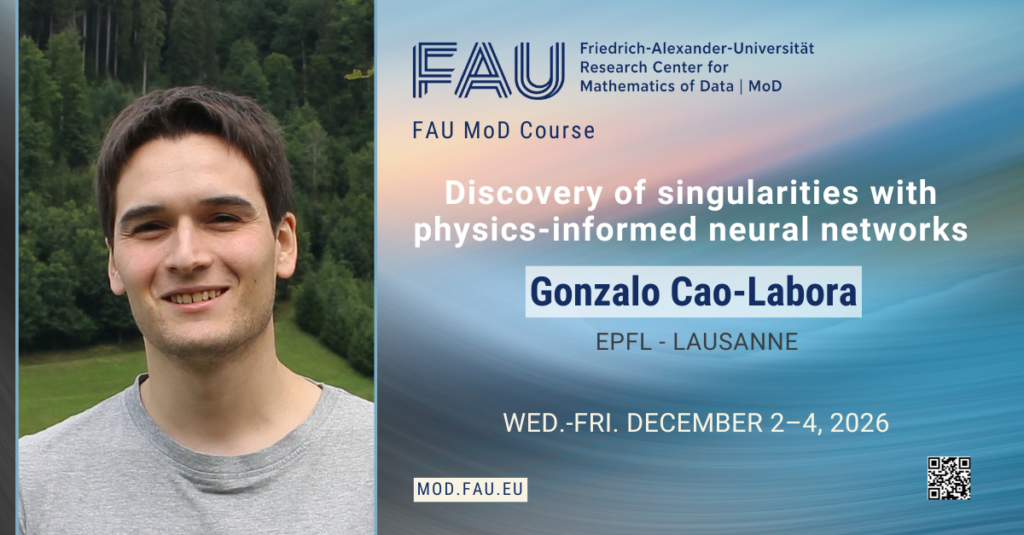
Date: Wed. – Fri. December 02 – 04, 2026
Event: FAU MoD Course
Organizer: FAU MoD, Research Center for Mathematics of Data at FAU, Friedrich-Alexander-Universität Erlangen-Nürnberg
FAU MoD Course: Discovery of singularities with physics-informed neural networks
Speaker: Prof. Dr. Gonzalo Cao-Labora
Affiliation: EPFL, École Polytechnique Fédérale de Lausanne
Abstract. The course will be concerned with recent strategies to rigorously prove self-similar singularity formation, where the candidate for the singularity is obtained via physics-informed neural networks (PINNs). This is one of the strategies currently being considered to tackle the major open problems in the analysis of fluids, such as singularity formation for incompressible Euler or for Navier–Stokes, the latter being the Clay Millennium Prize problem.
We will start by understanding the techniques in the simpler setting of the self-similar Burgers shock. Burgers is a 1-D model for compressible fluids that reflects the overall strategy while simplifying certain parts of the arguments due to being 1-D and local. Then, we will talk about the neural-network techniques and the mathematical reformulations of the problem that are useful in this context, in order to find a candidate for a self-similar singularity for fluids equations. Finally, we will explain how one can obtain a rigorous proof from such a candidate, which is intimately related to the question of the stability of these solutions and to the problem of turning an inviscid singularity into a viscous one.
BIO.- Gonzalo Cao-Labora did his BSc at UPC (Barcelona) under the double-degree CFIS program, completing his last year at Princeton University. Then, he obtained his PhD from the MIT – Massachusetts Institute of Technology in 2024. After having postdoctoral positions at the Courant Institute – New York University, he is currently at the École Polytechnique Fédérale de Lausanne, Switzerland.
His research touches different areas in PDE, such as Dispersive Equations, Elliptic Overdetermined Problems and Analysis of Fluids, where he studies aspects such as self-similar singularity formation, stability of singularities, and stability of vortices. Some of his recent research involves a more geometric flavour such as Schiffer-type problems or the existence of Einstein metrics.
Prof. Cao-Labora’s research benefits from the interaction of analytical arguments, computer-assisted proofs, and numerics. Recently, he has been involved in collaborating with other academics and machine learning experts from Google DeepMind in order to use neural networks (specifically, physics-informed neural networks, or PINNs) to discover new singularities. Those numerical discoveries can then be upgraded to rigourous mathematical singularities, combining computer-assistance and analytical arguments.
He has received the 2025 R. E. Moore Award and the 2026 Vicent Caselles Prize for his PhD thesis, awarded by the Spanish Mathematical Society and the BBVA Foundation.

AUDIENCE
This is a hybrid event (on-site/online) designed for advanced master’s students and beyond, focusing on in-depth discussions and technical insights.
Open to: Public, Students, Postdocs, Professors, Faculty, Alumni and the scientific community all around the world.
WHEN
Wed. – Fri. December 02 – 04, 2026
Time-table:
Wed. December 02, 2026 | Room H20 (10:00H – 12:00H)
Thu. December 03, 2026 | Room H21 (14:00H – 16:00H)
Fri. December 04, 2026 | Room H19 (11:00H – 13:00H)
WHERE
On-site / Online
[On-site] FAU, Friedrich-Alexander-Universität Erlangen-NürnbergCauerstraße 5a, 91058 Erlangen, Bavaria (Germany)
Felix-Klein building. Mathematik/Informatik
How to get to Erlangen? [Online] https://www.fau.tv/clip/id/63064
Short-link to share this event: https://go.fau.de/1ea-c
*Prof. Cao-Labora’s photo credits: © Archives of the Mathematisches Forschungsinstitut Oberwolfach
You might like:
• FAU MoD Lectures
• Upcoming events
• FAU MoD Courses & Workshops
• FAU/Jilin Workshop: Workshop on Recent Trends in Applied Mathematics and Machine Learning 2026
• FAU MoD Course: Discovery of singularities with physics-informed neural networks by Prof. Dr. Gonzalo Cao-Labora
• FAU MoD Lecture: Moving your robotic hand is a matter of time and practice by Prof. Dr. Claudio Castellini
• FAU MoD Lecture: Trustworthy AI: Reliable, Explainable, Revisable by Prof. Dr. Ute Schmid
• MLPDES26 workshop: MLPDES26, Machine Learning and PDEs Workshop (2026)
• FAU MoD Lecture: Reverse typography and the theory of shape: Can old books be brought back to life? by Prof. Dr. Jean-Michel Morel
• FAU MoD Lecture: A data-driven approach to closed-loop control of wound state progression to drive healing outcomes by Prof. Dr. Marcella M. Gomez
• FAU MoD Lecture: Data Driven Modeling for Scientific Discovery and Digital Twins by Prof. Dr. Dongbin Xiu
• FAU MoD Lecture: A long life: How desirable is it, evolutionarily speaking? by Prof. Dr. Hanna Kokko
• FAU MoD Lecture: Bridging numerics and scientific machine learning for industrial applications by Dr. Christopher Straub
• FAU MoD Workshop: FAU MoD Workshop (Dec. 2025) by Prof. Giovanni Fantuzzi | Prof. Denisa Martonova
• FAU MoD Lecture: Quantum firmware: optimal control for quantum processors by Prof. Dr. Tommaso Calarco
• FAU MoD Lecture: AI Components in PDE Solvers by Prof. Dr. Nils Thürey
• FAU MoD Lecture: Disruption in science and engineering happens at scale by Prof. Dr. Johannes Brandstetter
• FAU MoD Workshop: FAU MoD Workshop (Sep. 2025) by Prof. Lorenzo Liverani | Prof. Hagen Holthusen
• FAU MoD Lecture: Exemplary applications of machine learning and optimization in quantum chemistry by Prof. Dr. Andreas Görling
• FAU MoD Lecture & workshop: AI for maths and maths for AI by Dr. François Charton
• FAU MoD Lecture: Optimization-based control for large-scale and complex systems: When and why does it work? by Prof. Dr. Lars Grüne
• FAU MoD Lecture: Mathematics of neural stem cells: Linking data and processes by Prof. Dr. Ana Martin-Villalba
• FAU MoD Lecture: FAU MoD Lecture S. Jin / N. Liu (double session) by Prof. Dr. Shi Jin and Prof. Dr. Nana Liu
• FAU MoD Lecture: Do you think you understand sex and death? Why predictions about biological processes require more than just intuition by Prof. Dr. Hanna Kokko
• FAU MoD Lecture: FAU MoD Lecture. Special December 2024 by Prof. Dr. Holger Rauhut and Prof. Dr. Christian Bär
• FAU MoD Lecture: Measuring productivity and fixedness in lexico-syntactic constructions by Prof. Dr. Stephanie Evert
• FAU MoD Lecture: New avenues for the interaction of computational mechanics and machine learning by Prof. Dr. Paolo Zunino
• FAU MoD Lecture: Discovering and Communicating Excellence by Prof. Dr. Ute Klammer
• FAU MoD Lecture: Thoughts on Machine Learning by Prof. Dr. Rupert Klein
• FAU MoD Lecture: Using system knowledge for improved sample efficiency in data-driven modeling and control of complex technical systems by Prof. Dr. Sebastian Peitz
• FAU MoD Lecture: Image Reconstruction – The Dialectic of Modelling and Learning by Prof. Dr. Martin Burger
• FAU MoD Lecture: The role of Artificial Intelligence in the future of mathematics by Prof. Dr. Amaury Hayat
• FAU MoD Lecture: FAU MoD Lecture. Special November 2023 by Prof. Dr. Michael Kohlhase and Prof. Dr. Edriss S. Titi
• FAU MoD Lecture: Free boundary regularity for the obstacle problem by Prof. Dr. Alessio Figalli
• FAU MoD Lecture: Physics-Based and Data-Driven-Based Algorithms for the Simulation of the Heart Function by Prof. Dr. Alfio Quarteroni
• FAU MoD Lecture: From Physics-Informed Machine Learning to Physics-Informed Machine Intelligence: Quo Vadimus? by Prof. Dr. George Karniadakis
• FAU MoD Lecture: From Alan Turing to contact geometry: Towards a “Fluid computer” by Prof. Dr. Eva Miranda
• FAU MoD Lecture: Applications of AAA Rational Approximation by Prof. Dr. Nick Trefethen
• FAU MoD Lecture: Learning-Based Optimization and PDE Control in User-Assignable Finite Time by Prof. Dr. Miroslav Krstic
_
Don’t miss out our last news and connect with us!