
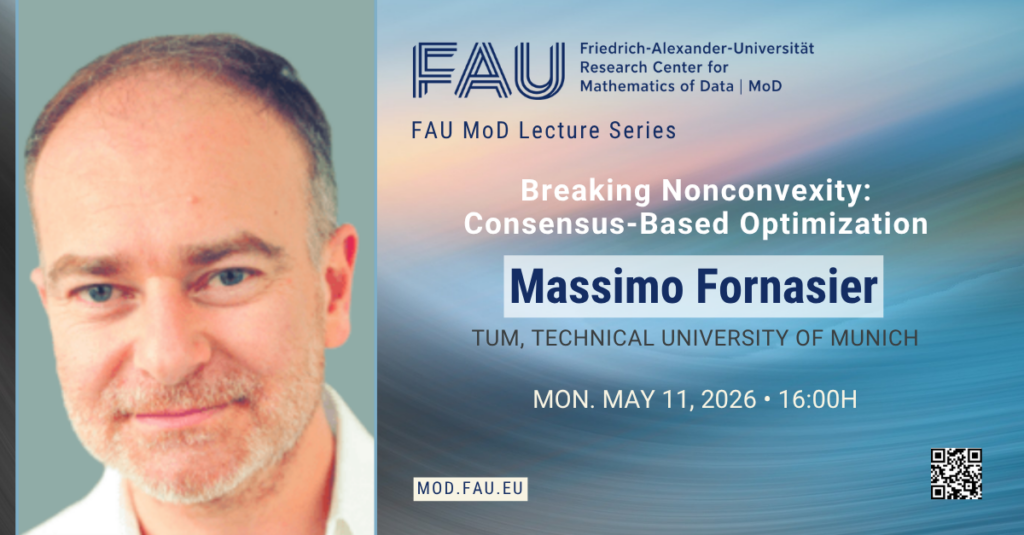
Date: Mon. May 11, 2026
Event: FAU MoD Lecture
Organized by: FAU MoD, the Research Center for Mathematics of Data at Friedrich-Alexander-Universität Erlangen-Nürnberg (Germany)
FAU MoD Lecture: Breaking Nonconvexity: Consensus-Based Optimization
Speaker: Prof. Dr. Massimo Fornasier
Affiliation: Department of Mathematics. Technical University of Munich (Germany)
Abstract. Nonconvex and nonsmooth optimization problems are ubiquitous across science and technology, appearing whenever models must capture complex real-world phenomena involving nonlinear interactions and structural constraints, from the extremely hard problem of protein folding to the computation of optimal operations of (humanoid) robots. Heuristics and local optimization methods are heavily used in practice, with limited success and often no theoretical guarantees. Establishing methods that can provably solve nonconvex optimization would open the door to approaching problems that currently remain inaccessible to rigorous mathematical analysis.
In this lecture we presented results of global convergence for Consensus-Based Optimization (CBO), which is a powerful and versatile zero-order multi-particle method designed to provably solve high-dimensional global optimization problems. The method relies on a balance between stochastic exploration and contraction toward a consensus point, which is defined via the Laplace principle as a proxy for the global minimizer.
We also show how Consensus-Based Optimization is collocated within the global optimization landscape, presenting how it is linked to other methods such as Simulated Annealing, Particle Swarm Optimization, Model Predictive Path Integral, Evolution Strategies. By establishing the bridge between them through CBO, we present novel results of global convergence for all these methods. New groundbreaking results in robotics are presented as an application.
VIDEO / RECORDING
Tip: Click the play button, then use the player controls to maximize the video player as needed.
Watch this lecture at our YouTube channel: https://www.youtube.com/@faumod
OUR SPEAKER
The research of Massimo Fornasier embraces a spectrum of problems in mathematical modeling, analysis and numerical analysis. Fornasier is particularly interested in the concept of nonlinear evolutions, whose discretizations yield efficient algorithms for data analysis, image and signal processing, and in the adaptive numerical solutions of partial differential equations or high-dimensional optimization problems.
Fornasier received his doctoral degree in computational mathematics in 2003 from the University of Padua, Italy. There he worked also for the realization of the Mantegna Project, i.e., the complete restoration of the Mantegna’s frescoes in the Eremitani Church in Padua, which were destroyed by a bombing in World War II. After spending from 2003 to 2006 as a postdoctoral research fellow at the University of Vienna and University of Rome “La Sapienza”, he joined the Johann Radon Institute for Computational and Applied Mathematics (RICAM) of the Austrian Academy of Sciences where he served as a senior research scientist until March 2011. He was an associate researcher from 2006 to 2007 for the Program in Applied and Computational Mathematics of Princeton University, USA. In 2011 Fornasier was appointed Chair of Applied Numerical Analysis at the Technical University of Munich.
Fornasier has received numerous national and international honors and awards. These include an invitation as a Speaker at the 7th European Congress of Mathematics in Berlin in 2016, the ERC Starting Grant in 2012, the Biennial Prize of the Società Italiana di Matematica Applicata ed Industriale (SIMAI) in 2012, the START Award of the Austrian Science Fund (FWF) in 2011, the Best Paper Award of the Austrian Academy of Sciences in 2010, and the Prix de Boelpaepe for image processing from the Royal Academy of Science, Letters and Fine Arts of Belgium in 2008. More recently, Fornasier was awarded an ERC Advanced Grant for his project NEITALG, which aims to develop new algorithms for reliably finding global solutions to challenging nonconvex optimization problems, with applications in drug development and AI safety.
AUDIENCE
This is a hybrid event (On-site/online) open to: Public, Students, Postdocs, Professors, Faculty, Alumni and the scientific community all around the world.
WHEN
Mon. May 11, 2026 at 16:00H (Berlin time)
WHERE
On-site / Online
[On-site] Friedrich-Alexander-Universität Erlangen-Nürnberg.Room H13. Johann-Radon-Hörsaal
Cauerstraße 11, 91058 Erlangen
GPS-Koord. Raum: 49.573764N, 11.030028E [Online] https://www.fau.tv/clip/id/63064
Shortlink to share this event: https://go.fau.de/1dhia
You might like:
• FAU MoD Lectures
• Upcoming events
• FAU MoD Courses & Workshops
• MLPDES26, Machine Learning and PDEs Workshop (2026)
• FAU MoD Lecture: A data-driven approach to closed-loop control of wound state progression to drive healing outcomes by Prof. Dr. Marcella M. Gomez
• FAU MoD Lecture: Data Driven Modeling for Scientific Discovery and Digital Twins by Prof. Dr. Dongbin Xiu
• FAU MoD Lecture: A long life: How desirable is it, evolutionarily speaking? by Prof. Dr. Hanna Kokko
• FAU MoD Lecture: Bridging numerics and scientific machine learning for industrial applications by Dr. Christopher Straub
• FAU MoD Workshop: FAU MoD Workshop (Dec. 2025) by Prof. Giovanni Fantuzzi | Prof. Denisa Martonova
• FAU MoD Lecture: Quantum firmware: optimal control for quantum processors by Prof. Dr. Tommaso Calarco
• FAU MoD Lecture: AI Components in PDE Solvers by Prof. Dr. Nils Thürey
• FAU MoD Lecture: Disruption in science and engineering happens at scale by Prof. Dr. Johannes Brandstetter
• FAU MoD Workshop: FAU MoD Workshop (Sep. 2025) by Prof. Lorenzo Liverani | Prof. Hagen Holthusen
• FAU MoD Lecture: Exemplary applications of machine learning and optimization in quantum chemistry by Prof. Dr. Andreas Görling
• FAU MoD Lecture & workshop: AI for maths and maths for AI by Dr. François Charton
• FAU MoD Lecture: Optimization-based control for large-scale and complex systems: When and why does it work? by Prof. Dr. Lars Grüne
• FAU MoD Lecture: Mathematics of neural stem cells: Linking data and processes by Prof. Dr. Ana Martin-Villalba
• FAU MoD Lecture: FAU MoD Lecture S. Jin / N. Liu (double session) by Prof. Dr. Shi Jin and Prof. Dr. Nana Liu
• FAU MoD Lecture: Do you think you understand sex and death? Why predictions about biological processes require more than just intuition by Prof. Dr. Hanna Kokko
• FAU MoD Lecture: FAU MoD Lecture. Special December 2024 by Prof. Dr. Holger Rauhut and Prof. Dr. Christian Bär
• FAU MoD Lecture: Measuring productivity and fixedness in lexico-syntactic constructions by Prof. Dr. Stephanie Evert
• FAU MoD Lecture: New avenues for the interaction of computational mechanics and machine learning by Prof. Dr. Paolo Zunino
• FAU MoD Lecture: Discovering and Communicating Excellence by Prof. Dr. Ute Klammer
• FAU MoD Lecture: Thoughts on Machine Learning by Prof. Dr. Rupert Klein
• FAU MoD Lecture: Using system knowledge for improved sample efficiency in data-driven modeling and control of complex technical systems by Prof. Dr. Sebastian Peitz
• FAU MoD Lecture: Image Reconstruction – The Dialectic of Modelling and Learning by Prof. Dr. Martin Burger
• FAU MoD Lecture: The role of Artificial Intelligence in the future of mathematics by Prof. Dr. Amaury Hayat
• FAU MoD Lecture: FAU MoD Lecture. Special November 2023 by Prof. Dr. Michael Kohlhase and Prof. Dr. Edriss S. Titi
• FAU MoD Lecture: Free boundary regularity for the obstacle problem by Prof. Dr. Alessio Figalli
• FAU MoD Lecture: Physics-Based and Data-Driven-Based Algorithms for the Simulation of the Heart Function by Prof. Dr. Alfio Quarteroni
• FAU MoD Lecture: From Physics-Informed Machine Learning to Physics-Informed Machine Intelligence: Quo Vadimus? by Prof. Dr. George Karniadakis
• FAU MoD Lecture: From Alan Turing to contact geometry: Towards a “Fluid computer” by Prof. Dr. Eva Miranda
• FAU MoD Lecture: Applications of AAA Rational Approximation by Prof. Dr. Nick Trefethen
• FAU MoD Lecture: Learning-Based Optimization and PDE Control in User-Assignable Finite Time by Prof. Dr. Miroslav Krstic
_
Don’t miss out our last news and connect with us!